Web Development Cost in 2026: The Honest Pricing Guide
Web development cost 2026, honestly explained: what a business website, store or custom app really costs in the US and Pakistan — and how to avoid overpaying

Ask ten people what a website costs and you will get ten numbers that cannot possibly describe the same product. A cousin quotes $800. An agency quotes $18,000. A founder on a podcast mentions $120,000. They are all telling the truth — they bought different things that happened to share the word "website".
This guide is our studio's honest attempt to end that confusion. We build websites for clients in the US and Pakistan every week, and the numbers below are what we see in real quotes, real invoices and real rebuilds in 2026. Not the cheapest number anyone has ever typed on a forum. Not the enterprise headline number either. The number you will actually pay, and why.
The short version: most small business websites in 2026 land between $3,000 and $15,000 when a freelancer or small studio builds them, and Clutch's 2026 buyer survey found that 61% of small business buyers spent under $10,000. Anything under $1,500 is a template with a handshake. Anything over $25,000 for a brochure site needs a reason you can say out loud. Everything in between is decided by scope — and scope is what this guide unpacks.
The 2026 price map: what different websites actually cost
Start with the part everyone scrolls to. These ranges come from current 2026 pricing analyses and what we see in our own pipeline, for a professionally built site with real design, proper mobile behaviour and basic SEO setup — not a DIY template, not a billion-dollar platform.
Those are US-market figures. If you hire in Pakistan, shave 50–70% off the agency numbers for the same project — a custom small business website that costs $8,000–$15,000 from a US boutique agency typically runs $2,500–$7,000 (roughly PKR 700,000 to PKR 2,000,000) from a competent Pakistani studio. The discount narrows on genuinely complex work, where architecture skill matters more than hourly rates, and it disappears entirely on enterprise builds that need compliance and on-call support across time zones.
Now the important part, the part the table hides: the spread inside each row. A $3,000 small business site and a $15,000 small business site are both "small business websites". Here is what the money actually buys at three levels.
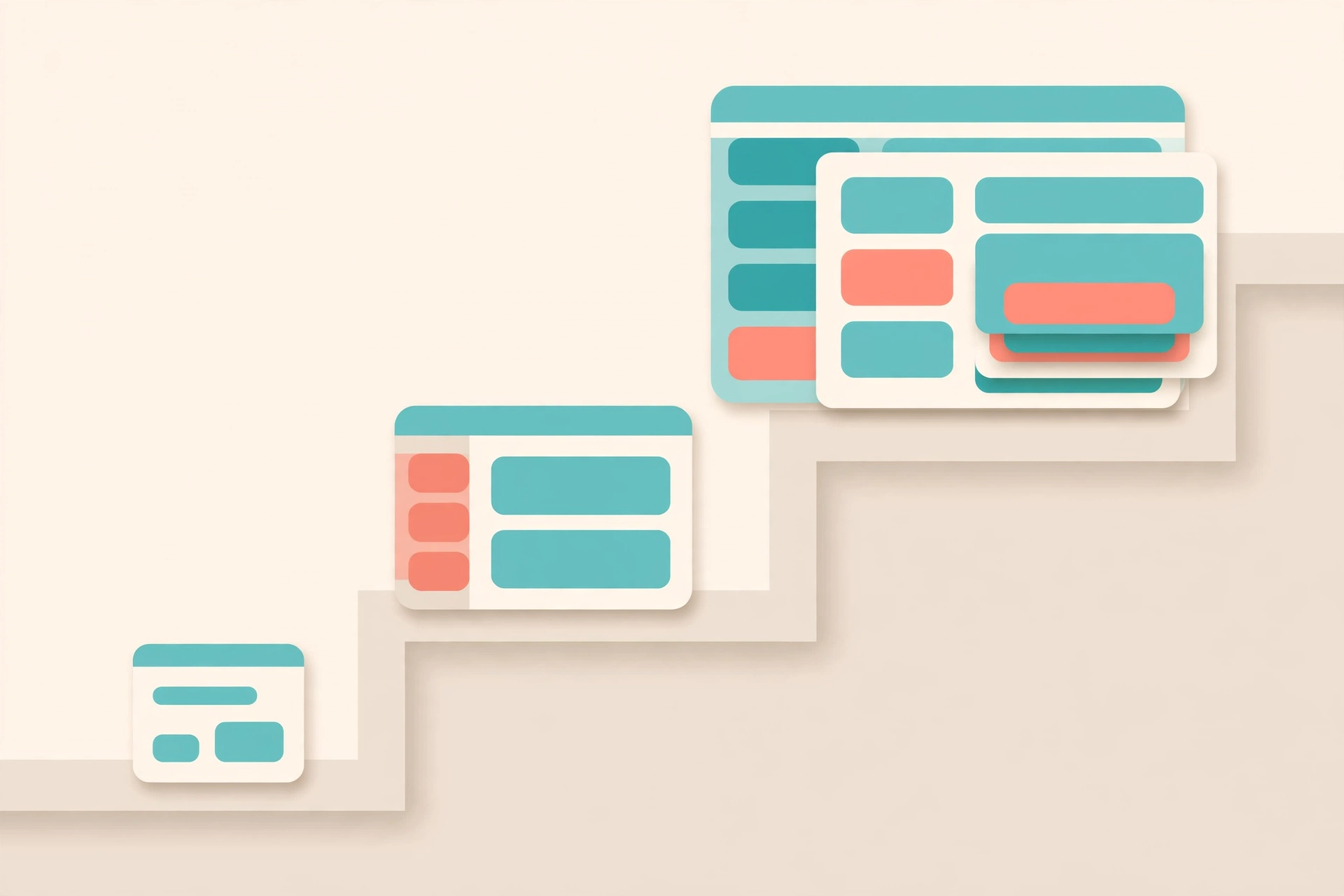
At $3,000–$8,000: the solid template build
A clean 5-to-10 page site on a proven platform — WordPress, Webflow, or a well-chosen theme on a modern stack. Your brand colours, your content, light customisation. Basic SEO setup: titles, meta descriptions, sitemap, analytics. What you do not get: custom page layouts beyond a few variations, bespoke illustrations, conversion copywriting, or any feature that does not already exist in a plugin. This is the right buy for a business that needs credibility fast — a law firm, a clinic, a consultancy that wins work through referrals and just needs the site to not embarrass them.
At $8,000–$25,000: the custom-designed site
Custom UI design from a blank canvas, not a theme. A designer thinks about your conversion path before a developer writes a line. Copy gets rewritten or written properly. Technical SEO is baked in rather than bolted on — proper heading structure, schema markup, Core Web Vitals treated as a requirement. You get custom components, thoughtful motion, and integrations with your CRM, booking system or email platform. This is where most of our clients land, and it is the price band where the site starts earning its keep instead of just existing.
At $25,000+: the built-for-purpose platform
Custom functionality that cannot be bought off the shelf: customer dashboards, multi-vendor logic, headless commerce, complex booking or quoting engines, AI features woven into the product. The design is the easy part; the money goes into backend architecture, security, testing and the unglamorous infrastructure that keeps it running. Buy this when the website is the business, not when it markets the business.
Notice what is missing from every row: a $500 "professional website". That product exists — it is called a template, and it is fine if you know that is what you are buying. The damage happens when a $500 template is sold with $15,000 promises.
Who builds it: freelancer vs agency vs DIY
The second decision, and the one where most buyers miscalculate. People compare hourly rates. They should compare total cost of a finished, working, maintained thing.
DIY is genuinely cheap in cash terms and genuinely expensive in time terms — the DIY-versus-freelancer-versus-agency breakdowns for 2026 put a small business DIY build at a few hundred dollars a year, which is exactly the trap. A founder who spends 80 hours wrestling a page builder has not saved $5,000; they have spent $5,000 worth of their own attention on a site that still looks like a template. DIY makes sense for a pre-revenue side project. It stops making sense the week your business depends on the site.
The freelancer-versus-agency call is subtler. A freelancer at $75/hour is cheaper than an agency at $150/hour — until the project needs four disciplines. Design, development, copywriting and QA are different jobs. One person doing all four does two of them badly, and the one they skip is usually the one that decides whether the site converts. Our rule of thumb: hire the freelancer for the straightforward build with a tight brief. Hire the agency when the brief is "we need this to work and we don't know exactly what 'this' is yet". An agency's single contract — with one throat to choke, as our clients put it — usually costs less than coordinating four freelancers and paying a fifth to clean up the seams.
There is a third option worth naming: the offshore studio. Not the $5/hour marketplace gamble — the real studio in Lahore, Karachi or Manila with a portfolio, a process and a phone number. Rates of $25–$75/hour buy you senior-level execution at junior US prices, with the honest trade-off of timezone overlap and a communication style you will need to manage. We are one, so take the bias as declared: for US clients, the offshore studio is how a $12,000 budget buys $25,000 of work. The projects that go wrong with offshore teams go wrong the same way they go wrong onshore — vague briefs and no one reviewing the work — not because of geography.
Hourly rates in 2026: the number behind the quote
Fixed quotes are built from hourly rates, so knowing the rates tells you whether a quote is sane. The US Bureau of Labor Statistics puts median web developer pay at $92,650 a year (May 2025 data, via this 2026 rate breakdown) — the bottom 10% earn under $48,100 and the top 10% over $162,290. Add taxes, benefits, equipment and leave, and a US developer costs their employer 1.25 to 1.4 times their salary. That is why a US agency cannot charge you $40/hour and survive: the person alone costs them more than that before the lights are on.
What that means for your quote:
- US freelancer: $45–$150/hour. The bottom of the range is junior or template work; the top is a specialist who finishes in a third of the time.
- US boutique agency: $100–$250/hour. You are buying the team and the process, not just the hours.
- Offshore studio (Pakistan, Philippines, Eastern Europe): $25–$75/hour. The range that makes our dual-market pricing work — senior talent, lower cost base.
- Dedicated monthly retainer: roughly $3,000–$6,000/month offshore, $14,000–$22,000/month in the US for a full-time-equivalent developer.
Our position, stated plainly: hourly billing is honest and fixed pricing is comfortable, and they serve different projects. Fixed protects you when the scope is tight and fully understood. Hourly protects you when you are still deciding what you want — which, in our experience, describes about 70% of projects at kickoff. Be suspicious of the fixed quote that arrives 24 hours after your first call. Nobody prices what they do not understand; they priced a template and called it custom.
What actually moves the invoice
Not the adjective in the proposal. These are the levers, in the order they hit the budget.
1. Scope: pages, features, and who writes the words
Every page is design time, build time and QA time. A 6-page site and a 40-page site are not the same project with different page counts; they are different projects. But the line item clients forget most often is content. "Client to provide copy" is the most expensive sentence in web development, because copy that arrives in week nine of a six-week project restarts the design clock. In our studio's observed range, projects where the client delivers final copy and photography before kickoff ship in half the time of projects where content trickles in. If you cannot write it yourself, budget for copywriting — it is cheaper than the delay.
2. Custom design versus a theme
A template-based site runs $1,000–$5,000; fully custom UI/UX design runs $5,000–$25,000+ on its own, before a line of production code. The honest trade: templates are faster and cheaper, but they cap your conversion rate at "looks like everyone else". Custom design earns its premium when your site has a job to do — generating quotes, booking consultations, selling a considered product. For a deeper look at the design side of this decision, our UI/UX design cost guide breaks down what studios charge for design alone.
Our judgment call: most businesses should land in the middle. A custom-designed homepage, key landing pages and conversion flows, with template-style treatment for the legal pages nobody reads. Full custom everywhere is a luxury; full template everywhere is a ceiling.
3. The stack: WordPress or Webflow versus custom code
WordPress or Webflow is cheaper than a custom Next.js application, full stop. A Shopify theme is cheaper than headless commerce. The stack decision is a ten-year decision wearing a price tag: the cheap stack costs less now and constrains you later; the custom stack costs more now and moves exactly where you point it. We build most marketing sites on modern frameworks because the performance and SEO headroom pays for itself — but we will tell a client to their face when WordPress is the right answer. A blog-heavy content site does not need a custom application, and anyone who sells you one is selling hours, not outcomes.
4. Integrations and the features nobody prices
Payments, booking systems, CRM connections, membership areas, multilingual or right-to-left layouts, social logins, real-time features, AI integrations — each one is a small project inside the project. A "simple" booking integration is never simple: it needs availability logic, confirmation emails, cancellation flows, time zones and the edge cases your receptionist handles without thinking. When a quote seems high, check the integrations list first. When a quote seems suspiciously low, check whether it is missing.
5. Testing, accessibility and the browser you forgot
Your site does not run in "the browser". It runs in Chrome on Android, Safari on an iPhone with an cracked screen's worth of old iOS, Edge on a corporate laptop that updates when IT allows it, and increasingly in AI browsers and in-app webviews. Real QA across that matrix costs real money, and skipping it is the most common source of "the site is broken" support tickets in month two. The browser landscape is also shifting under your feet: Chrome moved to a two-week release cadence in September 2026 as AI reshapes the security landscape, which means the web platform your site runs on now changes twice as fast as it used to. Sites built on solid, current foundations absorb that. Sites held together with five-year-old plugins do not — and the repair bills arrive as surprises.
6. Timeline pressure
A tight deadline is a price multiplier, not a scheduling detail. Rush work means overtime, parallel workstreams and skipped review cycles, and every one of those shows up in the quote. If your launch date is flexible, say so — it is worth 15–20%.
The hidden second invoice: what the site costs after launch
This is the section most pricing guides bury and most buyers discover the hard way. The build is the down payment. The site keeps costing money every month it exists.

For a small business site, budget $50–$300 a month — hosting, domain renewals, plugin and framework updates, daily backups, uptime monitoring and the occasional small fix. That is $600–$3,600 a year, and it is not optional: skipped updates are the top reason WordPress sites get hacked, and a hacked site costs more to clean than five years of maintenance would have.
For a custom site with real traffic, the range is $3,600–$24,000 a year once you count proper monitoring, security patching, performance tuning and content changes. The security line item deserves emphasis in 2026 specifically: September saw the Blue Moon exploit kit chaining Chrome V8 vulnerabilities with a Windows zero-day, a textbook case of AI-accelerated attacks weaponising the gap between a known fix and a deployed patch. Your website faces the same arithmetic — the window between a vulnerability being known and your site being patched is when you are exposed. A maintenance plan is what closes that window. Our website security hardening guide walks through the checklist we run on every client site.
The rule we give every client: over three years, total ownership usually costs about as much as the original build. A $10,000 site is a $20,000 three-year commitment. Budget that on day one or meet it as a surprise in month fourteen when the SSL certificate lapses, the contact form silently dies, and nobody notices for a week. Ask any provider, before you sign, whether maintenance is included, billed monthly, or billed hourly when things break. A small monthly plan is almost always cheaper than emergency repair after something breaks.
Where the money gets wasted
We have rebuilt enough sites to recognise the patterns. The expensive mistakes are rarely technical; they are decisions.
Overbuilding version one. The founder who needs a quote-request flow and a service catalogue, and commissions a customer portal with dashboards "for later". Later never comes, but the invoice did. Build the site your business needs this year. The portal can be phase two, priced when you know what it should do.
The template trap in reverse. Paying custom prices for theme work. If the proposal does not show you wireframes or design concepts before development starts, you are buying a theme at custom rates. Ask what is bespoke and what is bought; an honest studio answers in one sentence.
Designing before the message is clear. A beautiful site that says the wrong thing converts worse than an ugly site that says the right thing. The businesses that waste the most on web development are not the ones with bad developers — they are the ones who never decided what the site should make the visitor do.
Ignoring speed until it costs rankings. Performance is a cost issue twice over: slow sites convert worse, and Google's Core Web Vitals have made speed a ranking input for years. Fixing performance after launch — auditing, reworking images, refactoring render-blocking code — costs multiples of building it fast in the first place. Our Core Web Vitals fix-first guide covers the repairs we do most often, and almost all of them were preventable at build time.
No one owns the site after launch. The build finishes, the developer moves on, and the site enters its slow decay: un-updated plugins, expired certificates, content from two rebrands ago. Assign an owner on day one — a person, not a hope — with a maintenance plan behind them.
How to brief a quote so you don't get burned
Good quotes come from good briefs. Before you ask anyone for a number, write down:
- The one job of the site. "Get quote requests from commercial property managers" beats "look modern".
- Page list and features. Every page, every form, every integration, named explicitly.
- Content status. Final copy ready, draft exists, or "we need you to write it" — each is a different price.
- Examples you like and why. Two or three sites, with the specific thing you like about each.
- Timeline and budget range. Yes, state your budget. The myth that hiding it gets you a better price is backwards: hiding it gets you a quote for the wrong project.
Then read the quotes you get back with a suspicious eye. Red flags: a fixed price delivered suspiciously fast, no line items, no mention of revisions or post-launch support, no questions about your content or your customers. Green flags: questions that make you think, a phased proposal, maintenance priced separately and honestly, and a portfolio where you can click through to live sites that still look maintained.
On fixed versus hourly, our standing advice: fixed price when the scope is nailed down and you want budget certainty; hourly or a capped retainer when you are still discovering what you need. Most honest projects start as the second and convert to the first after the design phase. Anyone offering a fixed price for a project nobody has scoped is selling you a surprise.
Redesign vs rebuild: the cost decision nobody prices properly
Sooner or later every business faces this fork. The current site is tired, conversions are soft, and the question is whether to refresh it or start over. The costs differ by an order of magnitude — a redesign typically runs 30–50% of the original build cost, a rebuild 80–120% — so getting the call wrong is expensive either way.
Redesign when the bones are fine. The platform is current, the site loads fast, the CMS does not fight you — only the look, the messaging and the conversion flow are stale. A redesign keeps the engine and replaces the bodywork. Most "our website looks dated" problems are redesign problems, and they are the best value in web development: all the visible impact at a third of the cost.
Rebuild when the tech is the problem. The site breaks on browser updates. The CMS is so old that adding a page requires a developer. Page speed is unfixable because the theme loads eleven sliders. The mobile experience is a separate, neglected codebase. These are rebuild signals, and reskinning a rotten foundation just delays the same bill by eighteen months — with interest, because now you have paid for the reskin too.
Our test: can a competent developer add a new page template in a day without touching anything fragile? Yes means redesign. No — or nervous laughter — means rebuild. And if you are rebuilding, this guide is your budget; price the rebuild like a new build, because that is what it is.
FAQ
How much does a website cost in 2026?
Most small business websites land between $3,000 and $15,000 when built by a freelancer or small studio, and Clutch's 2026 buyer survey found 61% of small business buyers spent under $10,000. A serious custom build with real design work runs $8,000–$25,000, an online store $10,000–$60,000 depending on complexity, and a custom web application $25,000–$150,000+. Quotes under $1,500 are nearly always a template with your logo dropped in. For store-specific numbers, our ecommerce website cost guide goes deeper.
How much does web development cost in Pakistan compared to the US?
For the same project, expect Pakistani studios and freelancers to quote 30–50% of US boutique agency rates. A custom small business website that costs $8,000–$15,000 from a US agency typically runs $2,500–$7,000 from a competent Pakistani studio — roughly PKR 700,000 to PKR 2,000,000. The gap shrinks on highly complex work where architecture skill matters more than hourly rates.
Is it cheaper to hire a freelancer or an agency for web development?
A freelancer is cheaper on paper — $45–$150/hour versus $100–$250/hour at a US boutique agency — but the comparison that matters is total project cost and risk. One person is fine for a straightforward site; the moment you need design, copywriting, QA and ongoing support, an agency's single contract usually costs less than coordinating four freelancers and cleaning up the gaps between them.
How much does website maintenance cost per year in 2026?
Budget $50–$300 a month ($600–$3,600 a year) for a small business site — hosting, updates, backups and small fixes. Custom sites with real traffic run $3,600–$24,000 a year once you count monitoring, security patching and content changes. Over three years, ownership often costs about as much as the original build, so price it in on day one.
Why do quotes for the same website vary so wildly?
Because quotes are not pricing the same thing. One quote is a template with stock photography, another is custom design, copywriting, SEO setup, integrations and 30 days of post-launch support. The scope behind the number — pages, custom versus theme, CMS, payments, integrations, content migration, who writes the words — is what moves the invoice, not the headline adjective.
Should I redesign my website or rebuild it from scratch?
Redesign when the bones are fine: the platform is current, the site is fast, and only the look, messaging and conversion flow are stale. Rebuild when the tech is the problem — a site that breaks on every browser update, a CMS nobody can edit, or page loads your analytics prove are killing conversions. A rebuild costs 2–3x a redesign but a reskin of a rotten foundation just delays the same bill.
How long does it take to build a business website in 2026?
A small business website takes 2–6 weeks with content ready; a corporate site 1–3 months; an ecommerce store 2–6 months; a custom web app 3–12 months. The biggest timeline killer is not development — it's content. Sites where the client delivers copy and photos on day one ship twice as fast as sites waiting on them.
The number is not the point
A website is not expensive or cheap in the abstract. It is expensive relative to what it returns. A $4,000 template site that brings in two clients a year is a worse investment than a $20,000 custom site that brings in twenty. The question was never "how much does a website cost" — it is "what is the cheapest build that does the job properly, and what does properly mean for us".
That is the conversation we have with every client before we quote. If you want it too — a straight answer about what your project should cost, what it should include, and what you should skip — talk to our studio. We will tell you when the answer is "less than you think", and we have the services page to prove what we actually build.
Share this article
Keep reading
All articles
Deno's End of Life: The 2026 Migration Guide for Teams
Deno end of life is confirmed: Cloudflare acquired the team and the runtime gets one more year of fixes. Here is the migration playbook your team needs.

Website Redesign Cost 2026: The Honest Pricing Guide
How much does a website redesign cost in 2026? Real US and Pakistan pricing, project timelines, hidden costs, and the SEO-safe migration checklist for owners.

Ecommerce Website Cost in 2026: The Honest Pricing Guide
Ecommerce website cost in 2026, decoded: real price bands for Shopify, WooCommerce and custom builds in the US and Pakistan, plus hidden costs and red flags.
Next
Tell us what you're building.
A plan, a timeline and a fixed price within a day. Nothing starts until you agree to it.