Your Rank Tracker Is Lying to You: The 2026 Poisoned SERP Problem
Rank tracker accuracy collapsed in 2026: Google fed fake results to scrapers. Poisoned SERPs explained, how they wreck reports, and how to verify rankings.

In the last week of September 2026, one of our clients called in a panic. Their rank tracker showed the site had fallen out of the top ten for nearly every money keyword overnight. Organic traffic, according to Google Analytics, was completely flat. Nothing had changed on the site. No manual action, no spam update announcement that matched the dates.
The rankings had not moved at all. The tracker was wrong.
We know that now because of the biggest story in SEO data this autumn: Google has been handing automated SERP collectors results pages that look entirely normal but contain quietly swapped, fake listings. Enterprise rank tracker Nozzle analysed 27.5 million results pages and found 8% of them poisoned between mid-September and early October 2026 — against a baseline of 0.17%. Your tracker did not break. Google started lying to it.
This matters far beyond one spooked client. If you buy SEO, sell SEO, or report on SEO anywhere — from a startup in Karachi to a retailer in Texas — your ranking reports may currently contain fiction. Here is what we learned digging into the data, and the verification routine we now run before any ranking number leaves this studio.
The timeline: what happened and when
The story broke on 10 October 2026, when Nozzle published its analysis — the full breakdown of the 27.5 million-page study is worth reading. But the poisoning had been running for weeks by then. The timeline, pieced together from Nozzle's study and DemandSphere's parallel report, looks like this:
- 13 September 2026 — Google requests from Nozzle's collection infrastructure begin failing in large numbers. Something in Google's bot detection changes.
- 20 September 2026 — the first altered results pages appear. No errors, no captchas — just complete pages with wrong results.
- 24 September 2026 — Google's September spam update begins rolling out, clouding the picture: genuine ranking swings now overlap with fake ones.
- 27–29 September 2026 — the poisoning peaks. Roughly 27% of all collected SERPs on some days are altered. This is the weekend your tracker probably showed the most dramatic "collapses".
- 8 October 2026 — the spam update finishes rolling out.
- 10 October 2026 — Nozzle publishes; DemandSphere confirms it sees the same behaviour on roughly 11% of daily SERPs.
Google has not commented on the reports. Its only statement on record, from August, speaks of technical measures against abuse — which is exactly what this looks like: countermeasures aimed at the industrial-scale scraping that feeds AI search, with rank trackers caught in the crossfire.
A note on scope: the United Kingdom saw the lowest poisoning rate at 3.0%, the United States ran at 8.5%, and Austria topped the table at 18.8%. Device barely mattered. What mattered was the route the request took — one collection network Nozzle uses returned 1–7% poisoned pages while another returned 9–30% over the same days. Google is treating some requesters differently, not showing everyone different results. A person searching from their phone in Lahore or Chicago sees real results. A datacentre bot does not always.
What a "poisoned SERP" actually is
Let us be precise, because the industry slang is doing a lot of work here. A poisoned SERP is a full, normal-looking Google results page where most of the organic results that should be there have been replaced with other pages — many of them wildly irrelevant to the query. There is no error code. No captcha. The HTML template is the same. Nothing on the surface says "fake".
Nozzle coined the term and the detection method, which is the part worth understanding. You cannot spot poisoning by inspecting one page — the page is well-formed. You spot it by comparing against a keyword's history. Nozzle defined each keyword's "usual sites" as the domains in its top ten on at least 60% of checks between 20 August and 9 September 2026, before the change. A page counts as poisoned when fewer than half of those usual sites appear anywhere on it, and they return on a later check.
That is the giveaway: history. The swapped-in pages have no relationship to the keyword's ranking pattern, and the real results come back within days.
What replaces the genuine results is revealing. Social and forum pages flood in — Reddit gained about 8 percentage points of page-one presence on poisoned pages, Facebook 5.5, with LinkedIn, Instagram and Quora also rising. The AI Overview above the results shrinks too: it appears on 34.9% of poisoned pages versus 54.2% in the baseline. Meanwhile the parts of the page Google makes money from — ads and shopping modules — stay almost untouched. Priorities, we suppose.
The numbers that should make you nervous
Nozzle's dataset is one of the largest public SERP studies ever run: 27.5 million results pages across 49 countries. Here are the figures that change how we read rank reports:
Read that third row twice. On poisoned pages, a site that normally ranks for a keyword was gone from the top ten nearly 59% of the time. Your tracker stored that as fact. Your client dashboard showed a cliff. And 78% of the time, the "drop" healed within three days — because it was never a drop.
The effect on reporting is permanent, though. A tracker that gets an error or a captcha marks the collection as failed and retries. A tracker that gets valid-looking HTML writes the fake result into history forever. Four out of five poisoning spells lasted exactly one check, so your historical chart now has a phantom crater that will mislead you six months from now when you compare year-on-year. That is the quiet damage: not the panic, but the corrupted archive.
Why Google is feeding scrapers fake results
Google's official silence leaves room for theories, and we will be honest about which parts are proven and which are our reading of the situation.
What is proven: the poisoning targets automated collection, varies by network route, and leaves paid modules intact. It is a bot countermeasure.
Our read: this is Google's fight against the wholesale scraping of its index to train and ground AI answers. Billions of SERPs are scraped daily — by data brokers, by AI labs, by rank trackers, by the same tools feeding the "answer engines" now eating Google's traffic. A blunt block returns a 429 or a captcha, and the scraper just rotates its IP and retries. A fake page is subtler: the scraper never knows it was stopped. It poisons its own dataset and walks away happy.
If that is the strategy, rank trackers are collateral damage. They scrape Google the same way the AI scrapers do, from the same kinds of infrastructure. Google's anti-scraping cannon does not distinguish a rank tracker checking your keyword from a data farm harvesting results to build a ChatGPT competitor.
There is a cold logic to it. Google sells ads against real human attention; scrapers consume server capacity and give nothing back. Serving fake results to suspected bots converts a cost centre into a defensive weapon. And because the fakes look real, the bot operators have no incentive to evolve their evasion — the system is self-stabilising. Whether this becomes a permanent feature of Google's bot management is the open question. The rate has not returned to baseline: Nozzle was still measuring 5–11% poisoned pages daily in October. DemandSphere warns its figure "could change rapidly".
How to tell a real ranking drop from bad data
This is the practical heart of the matter. Late September 2026 was the worst possible timing: a genuine spam update rolling out (24 September to 8 October) overlapped with peak poisoning (27–29 September). A drop on 29 September could have been the update, bad data, or both. Here is the triage order we now use — it takes about fifteen minutes:
Step 1: Check Search Console first, not your tracker. Search Console's average position is recorded only when a real user actually saw your result on a real page. Google cannot poison what it never sent to a bot. If your tracker shows a cliff and Search Console is flat, the data is bad — full stop. One practitioner published the small script they now run against the Search Console API before believing any drop. The caveat: on 11 October Search Console itself ran more than 64 hours behind, so pull the data a couple of days after the event before judging.
Step 2: Look at the shape of the drop. Real algorithmic drops persist across consecutive tracker checks and usually concentrate on particular pages or query clusters. Poisoning affects whole keywords at once — the entire usual result set vanishes — and 80% of spells last exactly one measurement. A crater that appeared in one check and filled itself by the next check is data, not rankings.
Step 3: Run a manual spot-check. Search the keyword yourself in a clean browser session — logged out, or in a different location profile. If you are still there, the tracker is wrong. It is low-tech, but it settles arguments fast.
Step 4: Compare across tools. If two rank trackers that collect through different infrastructure disagree, one of them got a fake page. Tools whose collection runs through cleaner, residential-style routes have reported far lower poisoning rates than datacentre-based collection.
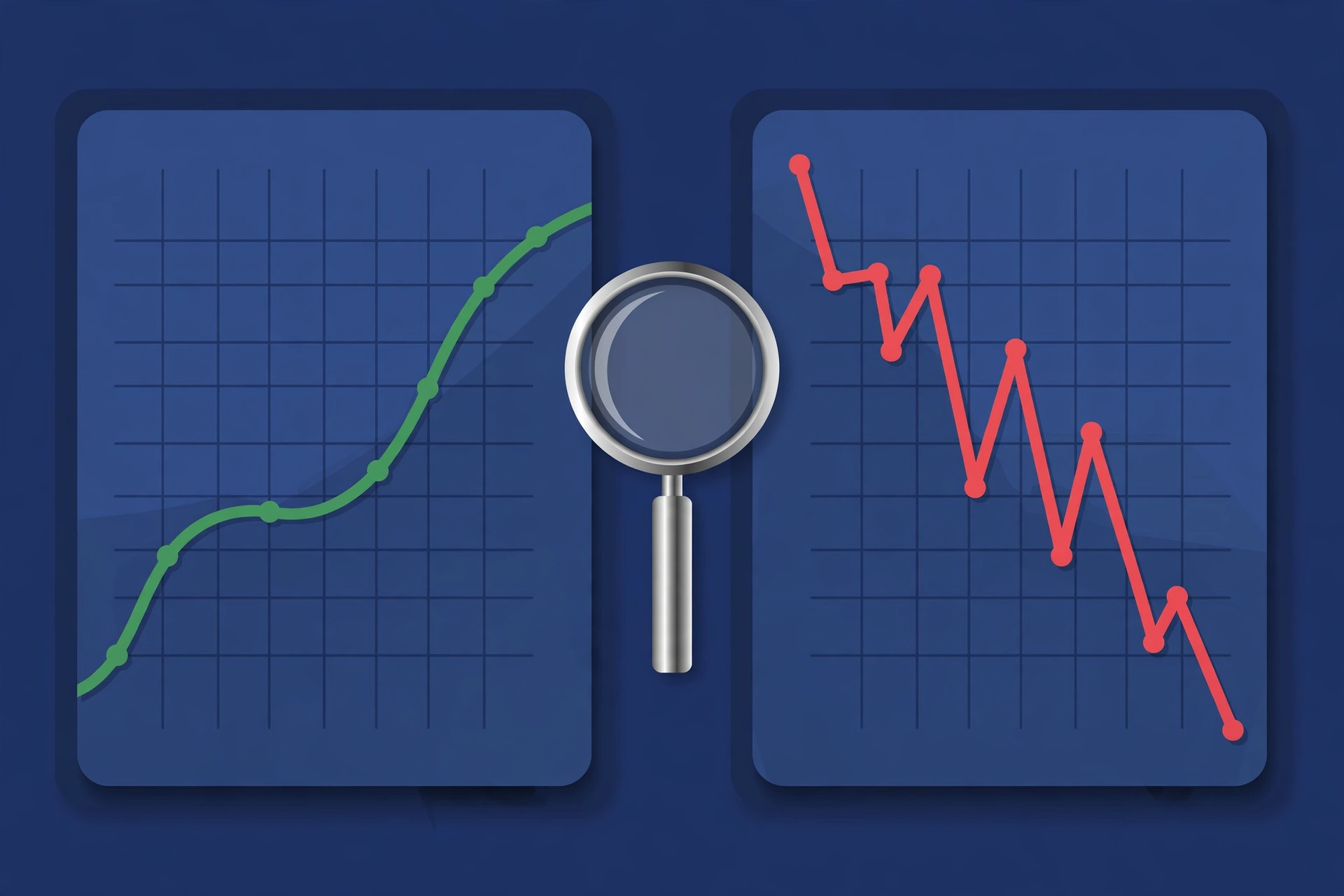
Step 5: Check your traffic. Rankings and traffic usually move together. A tracker "collapse" with unchanged clicks, impressions and revenue is almost certainly a data artefact. Search Console's Performance report is again the arbiter — it measures reality, not scrapes.
We now run this triage before any ranking movement goes into a client report. It has already caught two more phantom drops for other accounts in October. Neither client ever knew how close they came to a panic email.
Our studio's verification playbook for 2026
If you run SEO for clients — or you buy it from someone — here is the reporting stack we have settled on, and what we think the numbers are worth trusting:
-
Search Console is the source of truth for positions. Not your tracker, not a third-party tool — the only dataset that records what real humans saw. We have moved our month-end reporting to lead with GSC average position and impressions, with tracker data as a supplement. The new multi-country filtering Google rolled out this month — selecting several countries at once in the Performance report — makes this workable for our clients selling in both the US and Pakistan: one view, both markets.
-
Keep your tracker, but downgrade its authority. Trackers still earn their keep for spotting new keywords, tracking competitors, and giving fast directional signals. What they no longer are is a single source of truth. Treat every alarming single-check drop as unverified until the re-check.
-
Add AI-visibility metrics to your reports. Traditional rank tracking was already losing value before September. Google's AI Mode and AI Overviews now answer searches directly, and getting cited in AI answers is a separate skill from ranking. We now report brand mentions in AI Overviews, ChatGPT and Perplexity answers alongside classic positions. The irony is rich: the anti-scraping war Google is waging is partly about the AI tools that are redefining visibility, and your reports need to cover both.
-
Re-run before you report. Build a 48-hour confirmation rule into your process: no ranking movement reaches a client report until a second, independent check confirms it. It costs you two days of drama. It saves you from ever presenting fiction as fact.
-
Audit your historical data. If your tracker stores history — and most do — flag the late-September 2026 window in your records. Anyone comparing Q4 2026 to Q1 2027 needs to know some of those September dips were phantoms. A simple annotation beats a confused strategy meeting next spring.
For our own clients, this discipline is folded into the SEO and content work we run from the studio — about half our reporting conversations this month have touched on data trust rather than rankings. When you pay an agency for SEO, you are partly paying for someone who knows when the numbers are lying.

TrueRanker's write-up, updated 15 October, adds a worrying coda: while the obviously irrelevant results are mostly fixed, Google is now also serving pages whose results fit the query but still are not the real ones. Those are dramatically harder to spot — history comparison is the only detection, and even that gets murkier when the fakes look plausible.
How rank tracking actually works — and why poisoning breaks it
To understand why this went undetected for weeks, you need to know what a rank tracker does under the hood. It is not complicated, and that is the problem.
Every tracker — Ahrefs, Semrush, AccuRanker, Nozzle, the lot — runs the same loop: a fleet of servers sends thousands of Google searches per day from proxies, parses the returned HTML, and records which domains appear at which positions for which keywords. The trackers then average, smooth and chart the results into the tidy dashboards clients love.
Three assumptions hold that whole system together:
- The page is genuine. Scrapers assume Google serves bots the same results as humans. That assumption held for twenty years. It no longer holds.
- Failures are visible. Scrapers expect to be blocked with a 429 rate-limit, a captcha, or a connection reset — all of which the tracker flags as "collection failed" and retries. A fake page sails through validation because there is nothing invalid about it.
- Sampling is stable. A daily check of one location is treated as representative of what a user would see. When 5–11% of daily checks are fake, the sample is contaminated — and the tracker has no way to know which checks those are.
This is why the poisoning is worse than a block. A block degrades gracefully: you lose a data point and know you lost it. Poisoning degrades silently: you gain a data point that is wrong and treat it as gospel. Every downstream use — client reports, algorithm-update post-mortems, competitive analysis — inherits the lie.
And the contamination is not evenly spread. Nozzle found poisoning concentrated on particular collection networks, which means your tracker's accuracy depends on which infrastructure your vendor scrapes through — something vendors rarely disclose and you cannot check. The honest vendors will tell you their poisoning rate. Ask yours.
Ranking data sources compared: what to trust in 2026
Given all of this, where should each ranking question be answered? Here is how we score the options today:
The takeaway row is the last one. Even if poisoning vanished tomorrow, ranking data alone is answering a shrinking share of the visibility question. A client who ranks first but is never named in AI answers is losing the click to a competitor who ranks third and gets cited. Your 2026 reporting needs both columns.
On pricing, the honest ranges from tools we have run for clients: a solid single-site tracker starts around $30 a month (roughly PKR 8,500); agency-grade platforms with API access run $100–130 a month (PKR 28,000–37,000); adding AI-visibility tracking roughly doubles the stack. That is before anyone's time to verify the data. If an agency quotes you a full SEO retainer under $500 a month and promises precise daily ranking reports, ask where the verification budget lives — because at that price, there is not one.
What to do this week: the checklist
Enough theory. If you run a business, buy SEO, or sell it, here is the concrete list we are working through with our own clients this month:
- Annotate your data. Open your rank tracker and mark 13 September – 10 October 2026 as "suspect collection period". Anyone reading those charts next quarter needs the context.
- Re-verify every alarming drop from that window. Pull Search Console's average position for the same queries and dates. If GSC is flat, close the ticket. We have closed two this month.
- Fix your ChatGPT attribution. With UTMs stripped from ChatGPT links, add server-side referrer analysis or use ChatGPT's own referral patterns to recover the visits your analytics now files under "direct". Do not let AI traffic hide inside direct traffic — it is your fastest-growing channel.
- Turn on Search Console's AI reports. The generative AI performance reports are live for all sites now. Baseline your AI Overview visibility this month so you can measure it next month.
- Run the multi-country view. If you sell across markets — say the US and Pakistan — Google's new multi-country filter in Search Console lets you see combined performance in one report instead of tabbing between countries. Set it up once, save the view.
- Put a 48-hour rule in your reporting process. No single-check ranking movement reaches a client, a boss, or a strategy deck until a second check confirms it. Write it into your SOP so nobody has to argue it in a panic.
- Test your top ten queries in AI Mode. Gemini 4 Argon rolled into AI Mode on 13 October and handles multi-step follow-ups better — your pages need to answer the second and third question, not just the first. Run your money queries through AI Mode and note who gets named. If it is not you, that is your content gap list.
None of this is complicated. All of it is the difference between a report you can defend and one that falls apart the first time a client asks "are you sure?".
The reporting crisis is bigger than rank trackers
Poisoned SERPs are the headline, but they sit inside a wider unravelling of SEO measurement — and this is where the story connects to your business whether or not you track rankings.
ChatGPT traffic just went dark. Around mid-October, OpenAI stripped UTM parameters from the links ChatGPT sends to websites. Those visits now arrive recorded as direct traffic, or not attributed at all. The fastest-growing referral channel in search is suddenly the hardest to measure. If your analytics showed a mysterious bump in "direct" traffic this month, some of it is almost certainly AI referrals wearing a disguise.
Search Console's AI reports are the bright spot. Google's new generative AI performance reports — now available to all sites worldwide — finally let you see how often your pages appear in AI Overviews and how that visibility converts to clicks. The data is early and the click-through math is sobering, but it is real data, and it is the direction reporting has to move.
Trust is now the deliverable. Step back and the picture is clear: the ranking number your agency reports may be scraped fiction, the referral source your analytics shows may be mislabelled, and the visibility that matters most — AI answers — is only just becoming measurable. In that world, the value of an SEO partner shifts from "we rank you" to "we tell you what is actually happening, and we can prove it". That is a higher bar. It is also a real moat: anyone can sell you a position report; proving the number is real is the actual job now.
So here is our position, stated plainly: rank tracking in 2026 is a starting point, not an answer. Verify everything against Search Console. Measure AI visibility alongside classic rankings. And treat any single data source — ours included — as a claim that needs evidence, not a fact.
If your reports have been showing strange movements since September and you want someone to separate the signal from the fiction, talk to us. Untangling this is quite literally what we do all day.
Frequently asked questions
What is a poisoned SERP?
A poisoned SERP is a complete, normal-looking Google results page in which most of the genuine organic listings have been quietly swapped for irrelevant ones. There is no error and no captcha — the page looks perfectly real. Only comparison against a keyword's ranking history reveals the substitution. The term was coined by Nozzle in October 2026 after finding Google serving such pages to automated SERP collectors.
How much rank tracker data was affected?
Nozzle's study of 27.5 million results pages found 8.0% of SERPs were poisoned between 13 September and 9 October 2026, against 0.17% in the baseline period. The rate peaked at roughly 27% on 27–29 September. DemandSphere separately reported spurious results on about 11% of its daily SERPs.
How do I know if a ranking drop is real or a poisoned SERP?
Check Google Search Console's average position for the same queries — Search Console records positions only when a real user saw the result, so it is immune to this. If your tracker shows a collapse but Search Console is flat, the data is bad. Real drops also persist across consecutive checks and appear in manual searches; poisoned pages recover within about three days in 78% of cases.
Which tools are affected by poisoned SERPs?
Any tool that scrapes Google results automatically is exposed — that includes Nozzle itself, DemandSphere, and the rank-tracking features of Ahrefs, Semrush, AccuRanker and similar platforms, all of which collect SERPs the same way. The trackers did not break; Google changed what it serves to some automated requesters.
Has Google confirmed serving altered results?
No. Google has not commented on the poisoned SERP reports. Its only statement, from August 2026, refers to technical measures against abuse. The data pattern — poisoning concentrated on specific collection networks — points to anti-scraping countermeasures rather than a ranking change for human users.
What should agencies use instead of rank trackers in 2026?
Do not abandon trackers — re-verify them. Keep your tracker for trend direction, but treat Search Console as the source of truth for positions, add AI visibility tracking (mentions in AI Overviews, ChatGPT and Perplexity answers) to your reporting, and re-run any alarming single-check drop before it reaches a client report.
Share this article
Keep reading
All articles
Get Cited in AI Overviews: 2026 Guide After Google's October Update
Learn how to get cited in AI Overviews after Google's October 2026 links update. Our studio's playbook: data-backed tactics, structure rules and tracking.

Meta Ads in October 2026: 7 Changes That Hit Your Budget
Meta ads changes in October 2026: Andromeda retrieval, the Customer Lifecycle toggle, organic link-post caps, and new ChatGPT and Google inventory. What to do now.

Google's October 2026 Content Rules: The AI Content Survival Guide
Google's AI content guidelines (October 2026): manual fact-checking now critical, fake author profiles count as deception. Our studio survival playbook.
Next
Tell us what you're building.
A plan, a timeline and a fixed price within a day. Nothing starts until you agree to it.